Key takeaways
- STEM eligibility is determined by the CIP code printed on your I-20 — not by your program's name. Verify it against the DHS list before you enroll.
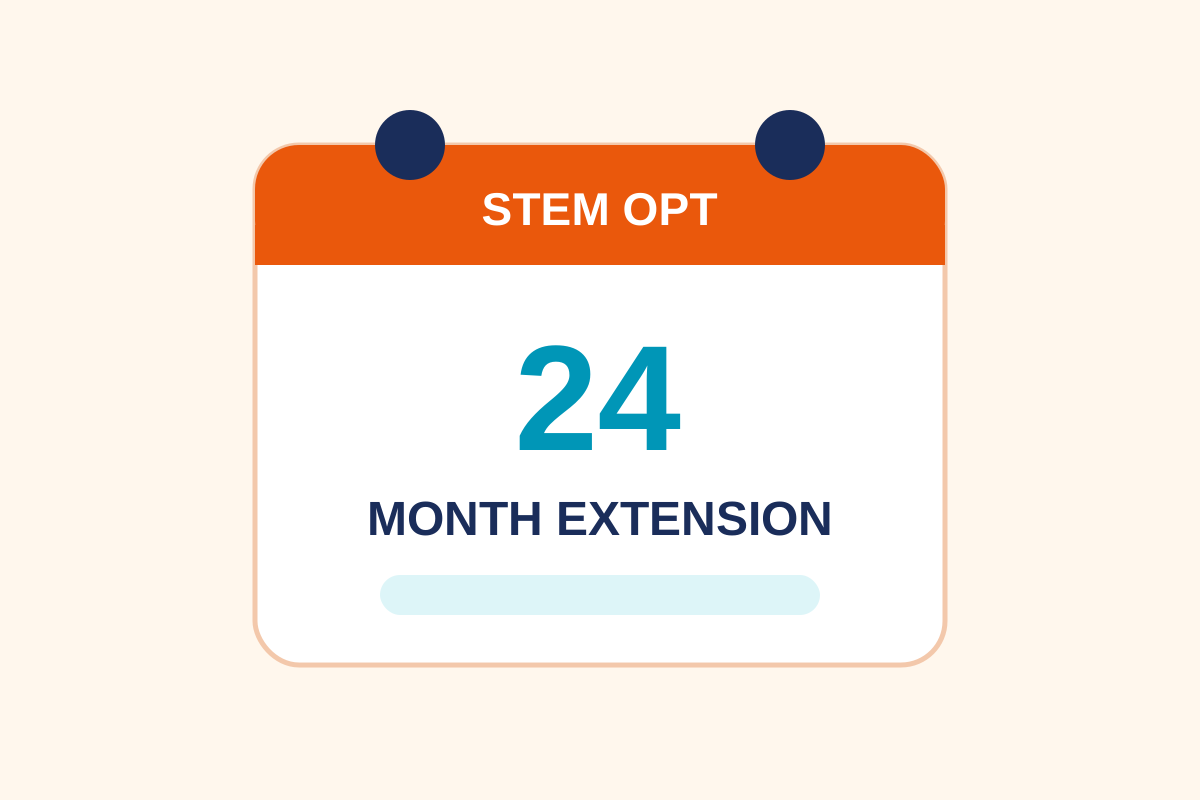
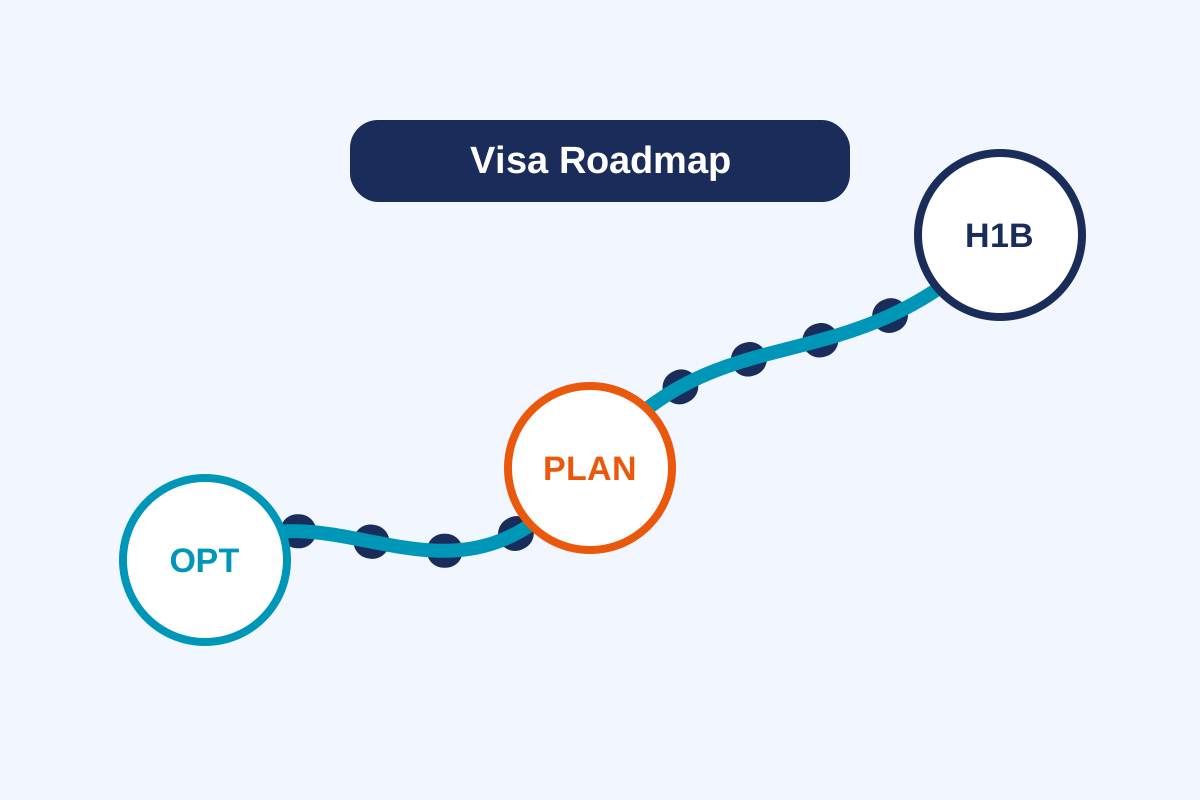
- A STEM-designated degree unlocks a 24-month OPT extension, giving you 36 months of work authorization and three shots at the H-1B lottery.
- Your STEM OPT employer must be enrolled in E-Verify, which rules out many small companies and most startups.
- Most MBAs are not STEM-designated. Some business analytics and management science variants are — again, the CIP code decides.
Choosing a university that is both CPT-friendly and STEM-designated is the single highest-leverage decision an international student makes, because it determines how many years you can legally work and how many attempts you get at the H-1B lottery. This guide covers how to verify STEM eligibility properly — most students get this wrong — and how to evaluate schools beyond the marketing.
Why STEM designation matters so much
Standard post-completion OPT gives you 12 months of work authorization. If your degree is STEM-designated, you can apply for a 24-month extension — 36 months in total.
The practical consequence is lottery attempts. With 12 months of OPT you realistically get one H-1B registration cycle. With 36 months you get three. Given recent selection rates, that difference is often the difference between staying and leaving.
| Degree type | OPT available | Realistic H-1B lottery attempts |
|---|---|---|
| Non-STEM | 12 months | One |
| STEM-designated | 12 + 24 = 36 months | Three |
The CIP code is what counts
This is the part students most often get wrong, and the mistake is expensive because it is usually discovered too late to fix.
STEM eligibility is not decided by your program's title, your department, or what an admissions officer told you. It is decided by the Classification of Instructional Programs (CIP) code your school assigned to your program, which is printed on your I-20. That code either appears on the DHS STEM Designated Degree Program List or it does not.
Two programs both called "Master of Science in Information Technology" can carry different codes at different schools. One yields a 24-month extension; the other yields nothing. If a school will not tell you the CIP code in writing before you enroll, treat that as a meaningful signal about how they handle student questions generally.
Fields commonly STEM-designated
- Computer science, software engineering, and cybersecurity
- Data science, analytics, and statistics
- All traditional engineering disciplines
- Mathematics and actuarial science
- Information systems — though this varies more than students expect
- Certain management science and business analytics programs
The E-Verify requirement
STEM OPT carries a condition that standard OPT does not: your employer must be enrolled in E-Verify. This is not negotiable and it eliminates a substantial share of employers — many small firms and a large proportion of early-stage startups are not enrolled.
Factor this into your job search from the beginning rather than discovering it during your extension application. You can check an employer's enrollment status before accepting an offer, and asking early is entirely reasonable. Your STEM OPT employer must also complete Form I-983, a formal training plan describing your learning objectives and supervision — some employers decline simply because they do not want the administrative burden.
Evaluating CPT-friendly schools
Once STEM eligibility is confirmed, apply the same scrutiny you would to any school offering early CPT. The criteria that predict a good outcome are unglamorous:
- Institutional accreditation from an accreditor recognized by the U.S. Department of Education — verify it yourself in the DAPIP database rather than trusting the school's website.
- A qualifying CIP code confirmed in writing before enrollment.
- A real academic program with genuine instruction, attendance expectations, and faculty who hold relevant terminal degrees.
- A DSO office that responds to detailed questions with specifics rather than reassurance.
- A student body that is not composed exclusively of CPT-seeking international students.
- Published employment and graduation outcomes.
- Total cost measured against realistic post-graduation earnings in your field.
You can browse CPT-friendly universities by region in our directory — Northeast, Midwest, South, and West — with program details and CPT policies for each institution. Use it as a starting point for your own verification, not as a substitute for it.
A word on the CPT and OPT interaction
If you are considering a school specifically for its early CPT availability, keep the trade-off in view: twelve months or more of full-time CPT eliminates OPT eligibility at that degree level — including the STEM extension you selected the program for in the first place. Students occasionally choose a STEM program for the 24-month extension and then use enough full-time CPT to forfeit it entirely. Track your cumulative full-time CPT days from your first authorization onward.
Frequently asked questions
- How do I find my program's CIP code?
- It is printed on page 1 of your I-20 next to your major. Before enrolling, ask the admissions or DSO office for it in writing, then search that exact code in the current DHS STEM Designated Degree Program List.
- Can a school change my CIP code so I qualify for STEM?
- Schools can update CIP codes when a program genuinely matches a different classification, but this is an institutional decision and cannot be made simply to benefit one student. Never enroll expecting a code to be changed later.
- Is an online STEM degree eligible for the OPT extension?
- F-1 status carries limits on how much of your coursework may be online, and fully online programs generally do not support F-1 status or OPT at all. Confirm the in-person requirements for your specific program with the DSO.
- Does the 24-month extension require the same employer as my initial OPT?
- No, but every STEM OPT employer must be enrolled in E-Verify and must complete Form I-983 for you. You can change employers during the extension provided each one meets those requirements and you report the change on time.
- Can I get a second STEM OPT extension with a second STEM degree?
- You may receive a STEM extension based on a higher degree level obtained later, subject to eligibility rules. You cannot receive two extensions for the same degree level. Discuss the specifics with your DSO before enrolling in a second program.
Official sources
About the author
CPTGuru Team — The CPTGuru editorial team researches F-1 regulations and works with licensed immigration attorneys and university DSOs to review guidance before publication.
Disclaimer: This article is general information about U.S. immigration regulations and is not legal advice. Immigration rules change frequently and apply differently to individual circumstances. Verify current requirements with official government sources and consult a licensed immigration attorney or your Designated School Official before acting on anything you read here. Last reviewed May 5, 2026.